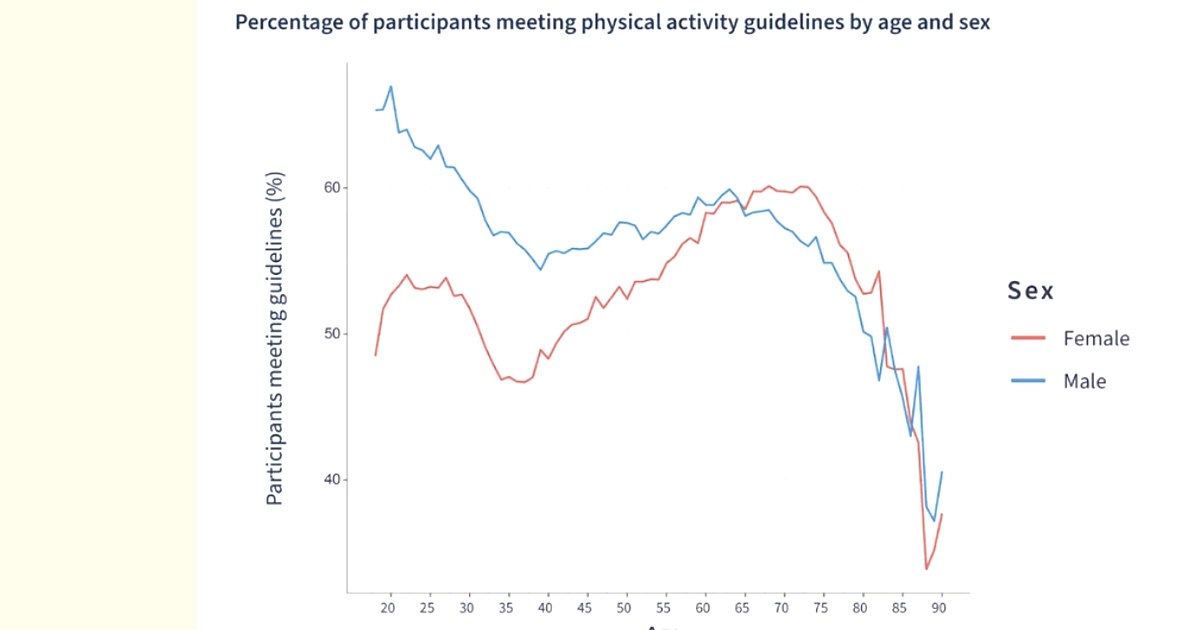
If exercise has slipped down your list somewhere in your thirties or forties, new UK data suggests you are in very good company. Our Future Health, one of the largest health research programmes in the country, looked at responses from 1,929,744 people and found a clear midlife exercise gap: the age groups least likely to meet physical activity guidelines are those roughly between 30 and 50 (Source: Our Future Health, 2026). Just over half of everyone in the study, 55.5%, currently meets the guidelines. The most active group was not young adults, but people aged 60 to 69.
Who this is for
This is for you if you are somewhere in the busy middle of life, with work, family, and everything else, and movement has become the thing that gets dropped first. You do not need a diagnosis or a big goal to read on. You just need a clearer picture of where you actually are, and what a realistic next step looks like from here.
What the data actually found
Our Future Health asked nearly 2 million people how much they move in a typical week, then compared their answers against the UK guidelines. Overall, 55.5% met them, made up of 57.5% of men and 53.4% of women (Source: Our Future Health, 2026).
The headline surprise was about age. Earlier surveys across England, Scotland and Wales tended to show young adults as the most active. This time, the group most likely to meet the guidelines was people aged 60 to 69, at 58.9%, just ahead of 18 to 29 year-olds at 57.6% (Source: Our Future Health, 2026).
There is also a quiet shift between the sexes later in life. Men are more likely to meet the guidelines overall, but women become more likely to do so after midlife, overtaking men around retirement age (Source: Our Future Health, 2026).
The midlife exercise gap
The dip in the middle is the part worth sitting with. Both men and women move less between roughly 30 and 50. The lowest point for working-age adults was the 30 to 39 group, where only 52.4% met the guidelines, followed by 40 to 49 year-olds at 53.5% (Source: Our Future Health, 2026).
That is not really a story about willpower. It tends to be the stretch of life with the least spare time of all: careers building, young children, ageing parents, and very little of the day left over for yourself. The exercise gap in midlife is mostly a time-and-life gap, not a motivation gap.
Seeing it that way changes what a sensible response looks like. It becomes less about finding more discipline, and more about finding the small pockets of movement that already fit inside your week.
Where you live makes a difference
Activity also varied by area. Adults in South West England were most likely to meet the guidelines, at 57.3%, while the West Midlands came in lowest at 52.4% (Source: Our Future Health, 2026).
If you are reading this in London, there is a small bright spot. London was among the more active areas at 57.1%, second only to the South West (Source: Our Future Health, 2026). People in rural areas were more active overall than those in towns and cities, and Scotland and North East England did the most walking of anywhere in the country.
Income and activity are linked
The data showed a steady link between income and movement. The share of people meeting the guidelines climbed with earnings, from 48.7% of those earning under £18,000 a year to 59.6% of those earning more than £100,000 (Source: Our Future Health, 2026).
That gap, almost 11 percentage points, is a reminder that staying active is not only about individual choices. Time, cost, safe places to move, and energy left at the end of the day all play a part. None of that means your own first step has to be expensive.
What the guidelines actually ask for
It helps to know what you are aiming at, because it is often less than people assume. The NHS suggests adults aged 19 to 64 do at least 150 minutes of moderate activity a week, such as brisk walking, or 75 minutes of vigorous activity like running, plus muscle-strengthening work on two days, spread across four or five days (Source: NHS, 2024).
That 150 minutes can be ten minutes here and there. A walk that leaves you slightly out of breath counts. So does carrying heavy shopping or a session of resistance exercise. You do not need a gym membership or a five-day plan to start closing your own midlife gap. You need one first thing that fits the week you actually have, not the week you wish you had.
New research from Our Future Health, based on 1,929,744 participants, found that 55.5% of adults meet UK physical activity guidelines, made up of 57.5% of men and 53.4% of women (Source: Our Future Health, 2026).
The least active age groups were 30 to 39 year-olds at 52.4% and 40 to 49 year-olds at 53.5%, showing a clear midlife exercise gap. The most active group was people aged 60 to 69, at 58.9% (Source: Our Future Health, 2026).
Activity levels rose with income, from 48.7% of people earning under £18,000 a year to 59.6% of those earning over £100,000 (Source: Our Future Health, 2026).
London was among the most active areas at 57.1%, second only to South West England at 57.3% (Source: Our Future Health, 2026).
The NHS recommends adults aged 19 to 64 do at least 150 minutes of moderate activity a week, or 75 minutes of vigorous activity, plus muscle-strengthening on two days (Source: NHS, 2024).
Questions people often ask
The NHS recommends adults aged 19 to 64 do at least 150 minutes of moderate intensity activity a week, such as brisk walking, or 75 minutes of vigorous activity like running. Alongside that, it suggests muscle-strengthening activities on at least two days, spread across four or five days (Source: NHS, 2024).
UK data from Our Future Health shows the lowest activity levels fall in the 30 to 49 age range, a pattern often called the midlife exercise gap (Source: Our Future Health, 2026). It tends to line up with the busiest years of work and family life, when spare time is at its lowest, rather than being about a lack of motivation.
In the Our Future Health analysis of nearly 2 million people, the age group most likely to meet the guidelines was 60 to 69 year-olds, at 58.9%, just ahead of 18 to 29 year-olds at 57.6% (Source: Our Future Health, 2026). This differs from several earlier surveys that placed young adults highest.
The Our Future Health data found that meeting the guidelines rose steadily with income, from 48.7% of people earning under £18,000 a year to 59.6% of those earning over £100,000 (Source: Our Future Health, 2026). Time, cost, and access to safe places to move are likely to be part of the picture.
Brisk walking counts as moderate activity, so it can make up a large part of your 150 minutes a week (Source: NHS, 2024). The guidelines also ask for muscle-strengthening on two days, which walking alone does not cover, so pairing walks with some resistance work gets you closer to the full picture.
This article is for general information only and is not a substitute for professional medical advice. If you are concerned about a specific symptom, please see a GP or other qualified healthcare provider.